
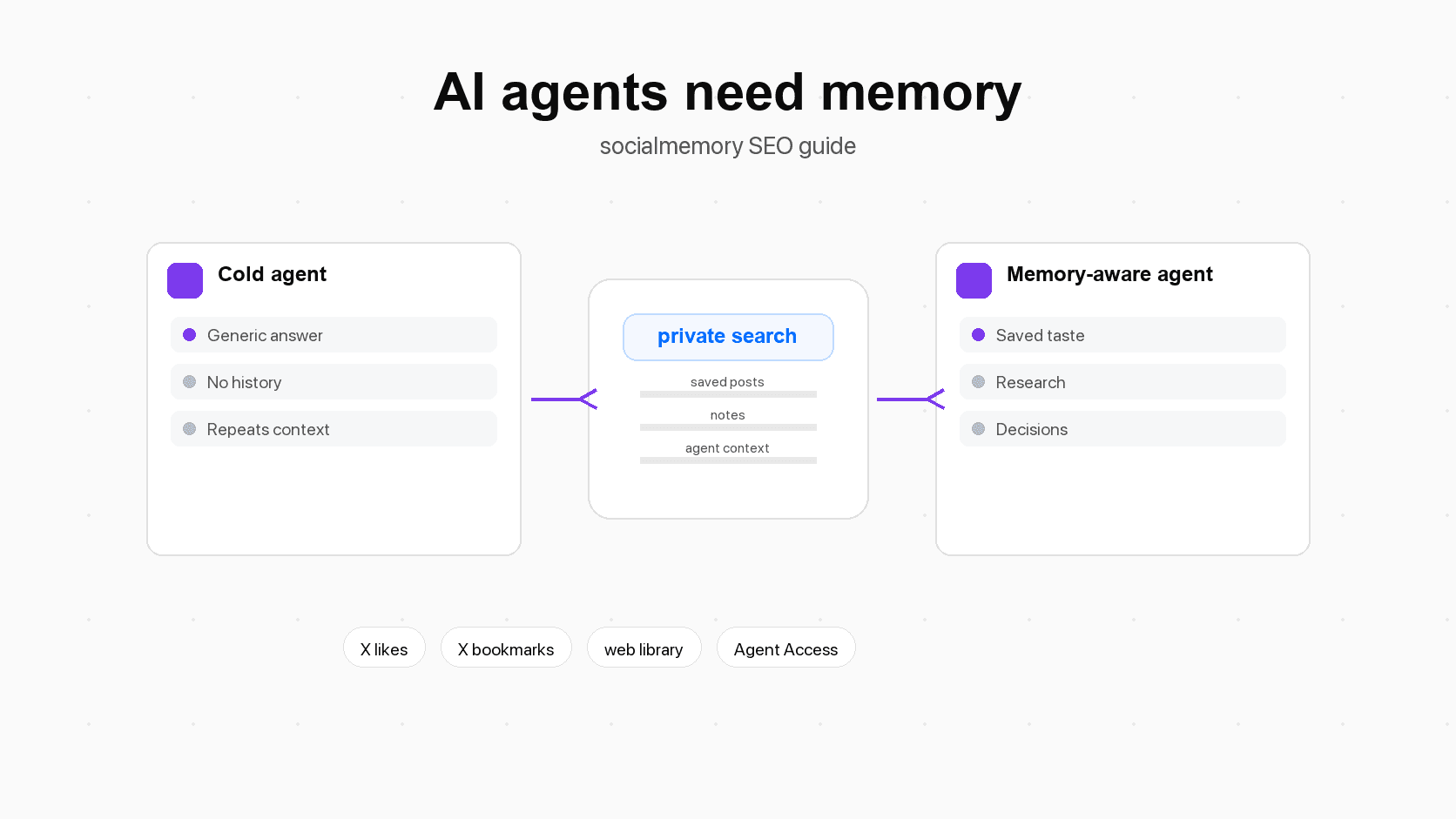
AI agents start cold without personal memory
An AI agent is an AI system that can do more than answer a single message. In plain language, an agent can take a goal, inspect context, call tools, make a plan, and work through steps. A coding agent like Codex or Claude Code can read code, draft changes, run checks, and help move a project forward. A general assistant like Claude can plan, write, and analyze. An editor agent inside a tool like Cursor can help where code is being written.
That sounds powerful, but the agent still has a basic problem: it only knows what it can see. If it cannot see the examples you saved, the decisions you already made, the libraries you prefer, or the UI references that define your taste, it has to infer those things from the current prompt.
What "agent" means in this article
The word "agent" can sound abstract. Here, it means an AI assistant that can work with context and tools: a repo, browser, terminal, search index, memory system, or external connector. The important point is that the agent is not just producing text. It is trying to help with a task, and that task gets better when the right personal context appears at the right time.
Why generic context is not enough
A generic agent can still explain common patterns, write boilerplate, compare tools, and reason through problems. But generic output often misses the things that make the work yours:
- your taste in design, copy, architecture, and product experience
- the examples you saved because they match your standards
- the project decisions you already made
- the tools, workflows, and corrections you prefer
Without memory, the user becomes the memory system. You copy links, paste notes, repeat preferences, explain project rules, and remind the agent about decisions it should already know. That is workable for one task. It breaks down when agents become a daily interface for building, researching, writing, and deciding.
What personal memory means for AI agents
Personal memory is stored context that an agent can retrieve later. "Stored" means the information lives somewhere outside the model's temporary working area. "Retrieve" means the agent can search or open the relevant part when the task needs it. This matters because modern work is not one prompt. A builder may spend months saving posts about agents, onboarding, pricing, code, design, and launch strategy. That material becomes useful only if it can come back during the work.
Durable context, not mind-reading
Personal memory is not magic. It does not mean the agent understands everything about you or reads your mind. It means the agent has controlled access to selected context.
Good personal memory includes:
- examples you saved and want to reuse
- project rules that should persist across sessions
- corrections you gave the agent before
- notes about what tone, style, or quality bar you prefer
- decisions you already made
- research links and source material
- saved X posts about code, design, product, strategy, and writing
- recurring workflows that worked well
Bad personal memory is everything dumped into one bucket. Raw chat history, browsing history, private secrets, irrelevant messages, and stale notes can make an agent worse.
Memory should be selected, searchable, and reviewable
The best agent memory has three properties. It is selected, so not everything gets saved. It is searchable, so the agent retrieves only what matches the current job. It is reviewable, so the user can see what the agent found, open the source, and correct the record. That is why saved X posts are interesting. A like or bookmark is already a human selection. It is not perfect, but it is a useful signal: "I thought this might matter later."
Context windows are temporary working space
A context window is the amount of information an AI model can actively see during one request or conversation. Think of it as the agent's temporary desk. It can hold the current prompt, recent messages, tool results, file snippets, and instructions.
That temporary desk is useful, but it is not the same as long-term memory.
| Concept | Plain meaning | What it is good for | Where it fails |
|---|---|---|---|
| Context window | The temporary working area the model can see right now. | Current conversation, selected files, recent tool output, immediate instructions. | It fills up, gets compressed, and does not reliably preserve months of personal context. |
| Long-term memory | Stored context that can persist across sessions. | Preferences, project rules, prior decisions, saved research, examples, corrections. | It can become noisy if everything is stored without curation. |
| Personal knowledge source | A specific archive the agent can search. | Saved X posts, notes, docs, project files, bookmarks, research libraries. | It only helps if it is searchable, private, and relevant to the task. |
| Agent retrieval | The act of finding the right memory at the right moment. | Bringing in useful context without pasting everything manually. | Retrieval can be wrong if the query is vague or the archive is messy. |
What a context window is
"Context" means the information surrounding a task. In AI tools, the context window is the limit on how much of that information can be present at once: the task, a few files, logs, instructions, tool results, examples, and recent conversation. It is active memory, not a complete personal archive.
Why long-term memory has to live outside the chat
If you try to put every preference, saved post, old decision, and project note into the prompt, the prompt becomes too large and too noisy. The agent has to spend attention on irrelevant material. Long tasks become harder to manage. Repeated work becomes expensive because the same context must be pasted again and again.
Long-term memory solves a different problem. It lets relevant context persist outside the current chat, then re-enter the task only when needed. That is why Claude Code has project memory concepts, why Claude exposes memory-tool patterns for persistent files, why Codex has skills and workflow instructions, and why MCP has become important as a connector standard.
What belongs in useful agent memory
The best personal memory for agents is not a diary of everything. It is a working library of reusable context.
| Memory type | Concrete examples | How an agent uses it | What to avoid |
|---|---|---|---|
| Preferences and taste | UI references, copy examples, architecture preferences, writing style notes. | Matches output to the user's quality bar. | Vague instructions like "make it good" without examples. |
| Project rules | Tech stack, naming rules, product boundaries, design-system rules, launch constraints. | Keeps edits consistent with the project. | Outdated rules that conflict with current code. |
| Prior decisions | "We rejected this onboarding flow," "pricing stays monthly," "Chrome sync is the primary path." | Avoids repeating old debates. | Decisions without rationale or date. |
| Saved examples | Landing pages, code snippets, workflows, launch posts, product demos. | Builds from examples the user already trusts. | Fake examples or screenshots without source links. |
| Research notes | Competitive notes, source articles, docs, threads, internal briefs. | Produces source-backed plans and summaries. | Unsourced claims or stale research. |
| Corrections | "Do not use this phrase," "ask before editing," "keep explanations beginner-friendly." | Improves repeated agent behavior. | Corrections that are too broad to apply safely. |
| Saved X posts | Liked and bookmarked posts about design, code, AI agents, pricing, and strategy. | Grounds work in the user's saved social knowledge. | Treating every saved post as true or current. |
Preferences and taste
Taste is hard to describe from scratch. A user can say "make the app feel premium," but that does not tell the agent whether the user prefers dense dashboards, editorial layouts, restrained typography, or utilitarian product surfaces. Saved examples make taste visible. The agent can search them before designing, then show how each recommendation maps back to something you saved.
Project examples and prior decisions
Prior decisions are memory too. If a team already decided that Chrome extension sync is the primary consumer sync path, an agent should not keep proposing a product flow that starts with a developer token. This kind of memory protects product consistency and keeps the agent from reopening decisions the project already made.
Saved X posts as high-signal research
X is messy, fast, and uneven. It is not a source of truth by itself. But for many builders, it is a discovery surface. People save posts about tools, lessons, launches, bugs, libraries, design references, pricing arguments, and AI workflows. Those saves are weak signals, but they are still signals.
When an agent can search those saved posts, it can find context that would otherwise stay buried in the scroll. It can say, "You saved several posts about onboarding friction. Here are the strongest patterns before I edit the onboarding page." That is very different from a cold agent inventing generic onboarding advice.
How saved X posts become agent memory
A saved X post becomes agent memory when it can be retrieved and used during a task. It might be a product screenshot, short opinion, launch thread, code snippet, design teardown, tool recommendation, or framework warning.
The key is that the post has to leave the feed and enter a searchable private library.
Likes and bookmarks are weak signals with real intent
Liking and bookmarking are lightweight actions. Sometimes you save a post because it is funny, useful, or worth revisiting. That means likes and bookmarks are noisy. But they are still more personal than a generic web search result because they came from your own behavior.
An agent should treat saved X posts as clues and examples, not as final authority. If a saved post recommends a package, the agent should still inspect the package, check the repo, read current docs, and run tests before installing it. If a saved post makes a pricing claim, the agent should use it as inspiration, not as proof.
Examples for design, code, pricing, launch, and writing
Saved X memory changes the starting point. A cold agent designs a generic settings page; a memory-aware agent searches saved UI references first. A cold agent suggests popular packages; a memory-aware agent finds libraries the user already saved and compares them against the repo. A cold agent writes generic SaaS copy; a memory-aware agent pulls saved copy examples, positioning notes, and rejected phrases. The agent does not become magically correct. It simply starts from your archive instead of starting from nowhere.
Codex, Claude Code, Claude, and Cursor all point at the same need
The agent tools people use today are different, but they point toward the same pattern: agents need external context to do serious work.
Codex needs project and taste context
Codex is a coding agent. OpenAI's Codex docs describe it as able to read, edit, and run code. That makes Codex useful for tasks like building features, fixing bugs, understanding unfamiliar code, and working through implementation steps.
But code alone is not the whole job. If Codex is editing a product page, it also needs product context. If it is designing a UI, it needs taste references. If it is implementing Agent Access copy, it needs to know that normal consumer copy should avoid jargon unless the page is explicitly technical.
Saved personal memory gives Codex a better starting point.
Claude Code shows why persistent project memory matters
Claude Code's memory docs are useful because they make the context problem explicit. Each session starts with a fresh context window, and persistent project files can carry instructions across sessions. A project instruction file can tell the agent how the repo works. A saved-post library can tell the agent what examples and outside ideas the user cared about before the task began.
Claude and Cursor make external memory part of the broader category
Claude's memory-tool docs describe storing and retrieving information across conversations through a memory file directory. MCP docs describe a standard way for AI applications to connect to external systems and data sources. Cursor's MCP docs point in the same direction for editor-based agents. For socialmemory, Codex, Claude Code, and Cursor are current first-class Agent Access targets.
Agent workflows that get better with personal memory
The best way to understand personal memory is to look at workflows. Agent memory is not valuable as an abstract feature. It is valuable when it changes the quality of work.
Project kickoff
Before starting a new project, ask the agent to search saved X memory for relevant examples, warnings, tools, and taste references.
Prompt pattern:
I am starting a project about [project].

Search my saved X posts for examples, tools, warnings, and opinions related to:
- [topic 1]
- [topic 2]
- [topic 3]

Return the 10 most useful posts, group them by theme, and write a kickoff brief. Do not edit files yet.
This works because saved posts often capture ideas months before they become relevant. The kickoff brief turns passive saving into active project context.
Frontend taste and design implementation
Design taste is one of the strongest reasons to connect saved posts to agents. If a user saved posts about restrained dashboards, clean onboarding, premium typography, or mobile layouts, those posts can shape the first draft before the agent writes code. A useful prompt is: "Before changing this UI, search my saved X posts for design references, summarize the patterns first, then inspect the app."
Debugging and library choices
Developers save bug threads and library recommendations constantly. A memory-aware agent can search those saves before guessing. The prompt should still require verification: "Use saved posts as clues, then verify against the current repo and official docs before suggesting a fix."
Strategy, pricing, launch, and writing
Agent memory is not only for code. The same saved-post library can help with strategy and writing:
- "Find saved posts about $12/month SaaS pricing and trial objections."
- "Find launch threads I saved from developer-tool founders."
- "Find posts about AI agent memory and turn them into an outline."
- "Find copy examples I saved for private, trustworthy data products."
- "Find my saved posts about weekly digests and turn them into a feature brief."
This is where personal memory becomes a work surface. The agent helps retrieve, organize, and reuse knowledge the user already collected.
How to build a useful private memory layer
A private memory layer is a system that lets your agent search your own context. The word "layer" simply means it sits between your raw information and the tools that use it. For socialmemory, the practical first layer is saved X memory.
Save selectively
The easiest memory system is the one you already use. If you already like and bookmark X posts, start there. Save posts that contain examples, tools, warnings, lessons, design references, or ideas you might want later. Add light structure only when it helps: tags like pricing, agents, frontend, launch, or onboarding.
Keep sources attached
Agents should be able to show their work. If an answer is based on saved posts, the user should see the posts. This is especially important for X, where posts can be insightful, outdated, incomplete, or wrong.
Keep secrets out
Personal memory should not become a dumping ground for secrets. Do not store passwords, private keys, payment secrets, customer data, or sensitive personal information just because an agent might use it someday. Good memory is scoped: enough context to help, not unnecessary access.
What personal memory unlocks next
The next version of agent work will not be "paste a giant prompt and hope." It will be more like this:
- before starting a project, the agent searches your saved examples
- before editing a design, it retrieves your taste references
- before choosing a library, it finds tools you already saved
- before drafting a pricing page, it gathers saved pricing arguments
- every week, it summarizes the best saved posts and turns them into actions
- when you repeat a correction, it remembers the correction for the next task
- when you ask for a brief, it uses your saved posts as source material
This is why personal memory matters. The agent becomes more useful when it has private, searchable context that belongs to the user.
For builders, X is often where early signals show up: a new repo, design pattern, founder lesson, pricing take, debugging warning, prompt pattern, or agent workflow. Socialmemory turns those saved signals into a library. Agent Access lets Codex, Claude Code, and Cursor use that library during work.
That is the practical path from passive saving to active memory.
Sources for Why AI Agents Need Personal Memory to Do Better Work
- URLUsed for short-term memory, long-term memory, episodic memory, semantic memory, procedural memory, and retrieval framing.
- URLUsed for the idea that agents are moving from responding to remembering through stored, recalled, and injected context.
- URLUsed for Codex positioning as a coding agent that can read, edit, and run code.
- URLUsed for reusable workflow and progressive-context framing in Codex.
- URLUsed for Claude Code project memory, fresh context window, and persistent instruction framing.
- URLUsed for storing and retrieving information across conversations through persistent memory files.
- URLUsed for the plain-language explanation of MCP as a standard connection between AI apps and external systems.
- URLUsed for the broader ecosystem claim that MCP connects AI systems with data sources through secure two-way connections.
- URLOfficial Cursor MCP documentation used for current Cursor Agent Access context.
- URLUsed carefully for the claim that many X users encounter news and current-events content on X, supporting X as a discovery surface. Do not overstate this as proof that X is always reliable.
- URLExisting article media. Use as a supporting video for memory vocabulary if kept.