
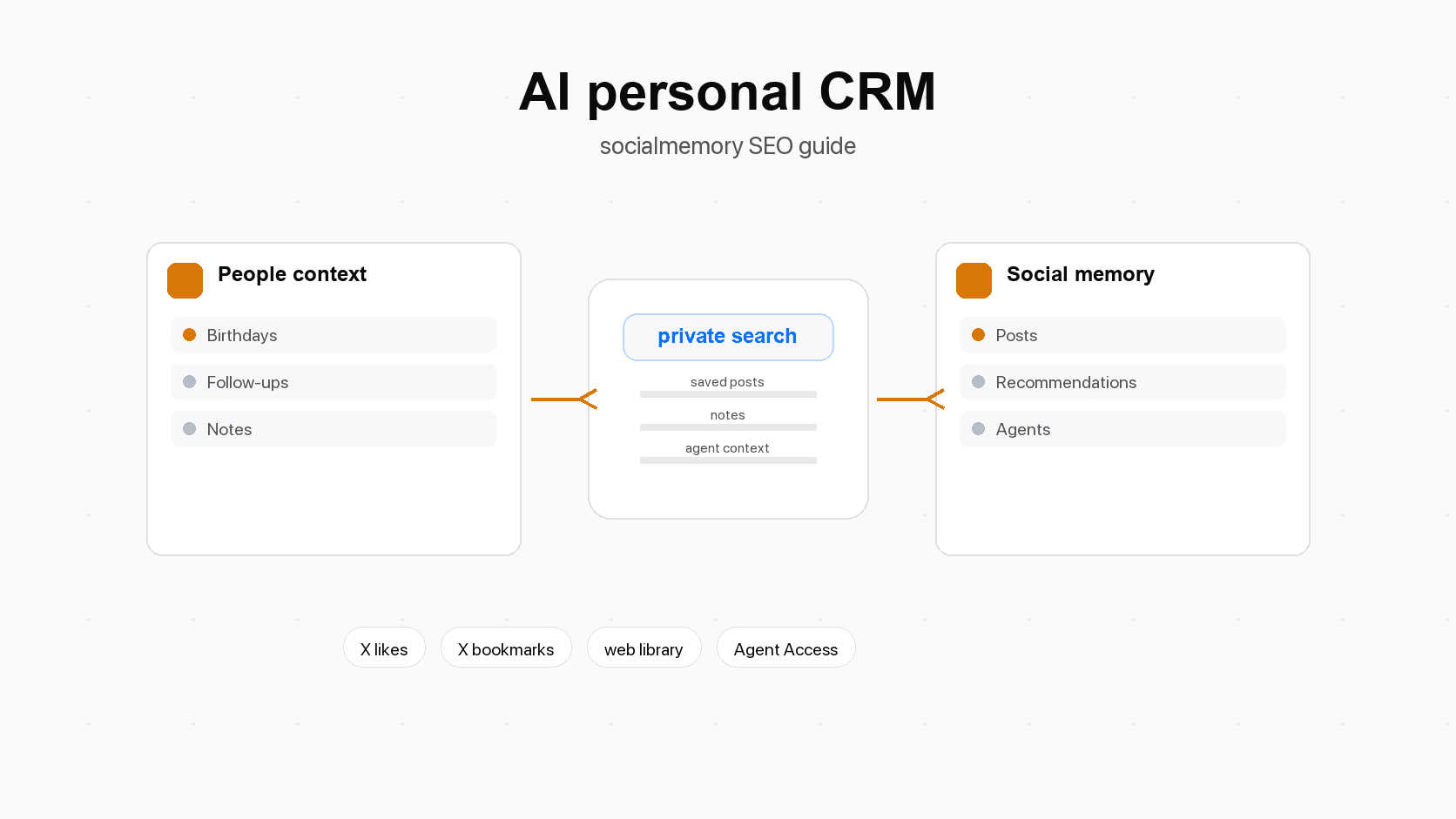
What AI personal CRM means
CRM in plain language
CRM stands for customer relationship management. The words come from business software: companies use CRMs to track customers, conversations, deals, follow-ups, notes, and history. In personal use, a CRM becomes a private place to remember people.
A personal CRM might help you remember:
- when you last spoke to someone
- what they are working on
- their birthday
- what you promised to send
- what they recommended
- when to follow up
- notes from your last conversation
That is useful because human memory is selective. You may remember that someone is interesting, but forget whether they care about AI agents, SaaS pricing, movies, design, or hiring. You may remember that a friend recommended something, but forget whether it was a book, a film, a tool, or a post.
The best personal CRM does not make relationships feel mechanical. It lowers the cost of being thoughtful.
What AI changes
AI changes personal CRM because the system can move beyond blank fields and manual reminders. Instead of only storing "birthday: June 8" or "last contacted: March 12," an AI-era system can help search the messy context around a person.
For example:
- "Who told me to watch that movie about memory?"
- "Which founder did I save posts from about pricing?"
- "What did this designer post that made me want to remember them?"
- "Which people in my network care about Claude Code, Codex, or Cursor?"
- "Before I message Sam, remind me what we last discussed."
This is where AI personal CRM starts to overlap with social memory. The system is no longer only a contact list. It becomes a retrieval layer. Retrieval means getting useful information back when you need it. The key question is not "Do I have the data somewhere?" The key question is "Can I find the right context at the right moment?"
Why personal CRM is not enough by itself
Classic personal CRM tools are strongest around people. They are weaker around the surrounding context that explains why a person matters. A contact record can tell you someone works at a company. It may not remember the post they wrote about pricing, the article they recommended, the open-source library they launched, or the movie they told you to watch.
That missing context matters because relationships are not only made of structured fields. Structured fields are neat labels like name, email, birthday, company, tags, or last-contact date. Real life includes recommendations, posts, links, notes, messages, projects, jokes, and ideas.
AI personal CRM points toward a larger system: relationship memory plus content memory plus agent-readable context.
Why contact-only memory misses the real context
Relationships live across more than contacts
Most personal memory is scattered. A person's email may be in Google Contacts. A birthday may be in a calendar. A note may be in Apple Notes. A project plan may be in Notion. A reading highlight may be in Readwise. A web bookmark may be in Raindrop. A connected idea may be in Obsidian. A research packet may be in NotebookLM. A post you saved from that person may be buried in X.
Each tool holds a different piece of memory. None of them automatically knows the whole story.
That is why contact-only memory feels too small. If your system only remembers people as rows in a database, it misses the context that made those people meaningful. The person is not just "Maya, investor, lives in New York." They might also be:
- the person who shared a great post about onboarding
- the person who recommended a documentary
- the person who keeps posting thoughtful notes about AI agents
- the person whose design taste you trust
- the person whose birthday you want to remember without being awkward
The memory is social because it connects people, ideas, recommendations, and timing.
The questions a useful memory layer should answer
A real AI personal CRM should answer questions that ordinary contact apps do not handle well:
| Memory question | Why it matters | Where the answer might live |
|---|---|---|
| Who recommended that movie? | Recommendations are relationship context, not just entertainment. | Messages, notes, X posts, Apple Notes, or a future social memory layer. |
| What did this founder write about pricing? | The post explains their expertise and why you saved them. | Saved X posts, bookmarks, notes, or Readwise. |
| Who do I know who cares about AI agents? | Useful before asking for feedback, hiring, or starting a project. | X likes/bookmarks, tags, CRM notes, Notion docs. |
| What birthday or follow-up should I remember this week? | Memory should help with thoughtful action. | Personal CRM, calendar, notes, reminders. |
| What posts did I save from people I might want to reconnect with? | Saved posts can reveal dormant relationships. | socialmemory library, X bookmarks, saved result sets. |
| What examples match my taste? | Taste is built from repeated choices, not one explicit note. | X likes, bookmarks, design references, Obsidian notes. |
This table is the core argument. AI personal CRM is about recovering useful context from traces you already leave behind.
The missing layer between CRM, notes apps, bookmark managers, and agents
Every tool has a best role
The future is not one app swallowing every other app. A good memory system lets each tool do its best job.
Notion is strong for structured workspaces and project docs. Apple Notes is strong for quick capture. Evernote is known for clipping web pages into notes. Raindrop is a broad bookmark manager. Readwise is strong for highlights and resurfacing. Obsidian is strong for linked local notes. NotebookLM is strong when you want an AI research workspace grounded in chosen sources.
Socialmemory should not pretend to replace those tools. Its useful wedge is narrower: saved X memory. X (formerly Twitter) is where many builders, founders, designers, and developers discover people, opinions, tools, code snippets, product lessons, design references, and recommendations. Socialmemory turns the X posts you already liked or bookmarked into a private library that can be searched, organized, and used by agents.
Tool comparison for AI-era personal memory
| Tool or category | Best role | What it usually misses | How socialmemory complements it |
|---|---|---|---|
| Personal CRM tools | People, reminders, birthdays, relationship notes. | Saved social posts and recommendations. | Adds saved-X context around people, taste, and intent. |
| Notion | Docs, databases, plans, dashboards. | Passive social signals unless copied in. | Keeps X memory searchable without forcing posts into Notion. |
| Apple Notes and Evernote | Quick notes, checklists, clipping, archived pages. | X-specific saved-post and agent workflows. | Gives saved posts a dedicated home. |
| Raindrop and Readwise | Bookmarks, highlights, resurfacing, saved reading. | Agent-readable saved X memory. | Turns X saves into searchable social memory. |
| Obsidian | Linked notes and long-term thinking. | Passive social saves unless imported. | Feeds social context into deeper notes. |
| NotebookLM | Source-grounded AI notebooks. | Ongoing social discovery. | Helps identify saved posts worth turning into source packs. |
| Codex, Claude Code, Claude, Cursor | Agent interfaces for work. | Personal context unless connected. | Supports Codex, Claude Code, and Cursor today. |
This comparison is important for positioning. The article should not say "replace your notes app" or "replace your CRM." The stronger claim is: AI personal CRM needs a social memory layer, and saved X posts are one of the highest-signal places to start.
Why posts and recommendations belong in relationship memory
Posts reveal expertise, taste, and timing
A saved post can be a better memory cue than a contact field. If you save someone's post about AI onboarding, that post tells you why the person matters. If you save five posts from someone about design systems, that repeated pattern says something about their expertise and your taste. If you bookmark a pricing thread from a founder, you may want that context before building your own pricing page months later.
This is why posts belong in relationship memory. They are not just content. They are evidence of what a person knows, what you noticed, and what you may want to reuse later.
Examples:
- You save a post from a designer because the screenshot matches your product taste.
- You like a post from a founder because their trial-pricing argument is useful.
- You bookmark a thread from an engineer because it explains a tricky browser-extension bug.
- You save a recommendation for a movie because a friend with good taste posted it.
Each one is a tiny relationship between a person, an idea, and your future self.
Recommendations are memory
Recommendations are easy to lose because they often arrive casually. Someone mentions a movie in a group chat. A founder posts a book recommendation. A designer shares a gallery. A developer recommends a library. A friend says, "You would like this place."
Those recommendations become useful later, but only if you can retrieve them. In a future social memory layer, you might ask:
- "What movies did people I trust recommend this month?"
- "Who recommended the notebook app I wanted to try?"
- "What did my design friends recommend for portfolio inspiration?"
- "Which AI tools did I save from people I actually trust?"
That is not ordinary CRM. It is also not ordinary bookmarking. It is social memory: remembering useful signals because they came from people, not just because they were links.
Public saved posts are a safer first wedge
The most sensitive version of AI personal CRM would involve private messages, emails, calendars, contacts, location history, and deep personal notes. That could be useful, but it requires careful permissions, clear boundaries, and strong trust.
Socialmemory starts in a safer and more practical place: the X posts you already liked or bookmarked. These are still private to your account when saved into socialmemory, but they are generally public posts you intentionally marked as useful. That makes saved X memory a better first step than trying to mine every private conversation.
The product should still be careful. Socialmemory should not claim it can access deleted, protected, unavailable, or never-synced posts. It should not claim to know your private relationships. It should say the true thing: saved X posts often contain useful personal context.
A practical model for AI-era personal memory
An AI-era memory system needs people memory, context memory, taste memory, and action memory. People memory covers names, birthdays, follow-ups, promises, and relationship notes. Context memory covers saved posts, links, notes, recommendations, meetings, and messages. Taste memory comes from patterns in what you save, like, favorite, and annotate. Action memory turns all of that into what to revisit, summarize, ask, draft, tag, or bring into a project. This is where Codex, Claude Code, Claude, and Cursor become relevant: agents can search, summarize, compare, draft, and help you decide when the memory source is connected and the user stays in control.
Example workflows
Before writing someone
Imagine you are about to message a founder you met months ago. A contact app can show their name and company. A better memory layer can show the posts you saved from them, the topics they keep writing about, the recommendation they gave you, the follow-up you forgot, and whether they care about Codex, Claude Code, pricing, design, hiring, or AI agents. The output is not a sales script. It is a short personal briefing so you can write like a thoughtful human.
Before starting a project
Before building a new project, ask the agent to search saved X memory for relevant examples.
| Project | Useful saved memory | Agent request |
|---|---|---|
| New landing page | Saved posts about positioning, hero sections, pricing, proof, and onboarding. | "Find my saved posts about landing-page positioning and turn them into a critique checklist." |
| AI personal CRM prototype | Posts about personal CRM, agent memory, MCP, notes apps, and relationship reminders. | "Find saved posts that explain what people want from AI memory and relationship tools." |
| Chrome extension | Posts about X, browser extension bugs, sync states, cookies, permissions, and onboarding. | "Search saved posts for extension lessons before inspecting this repo." |
| Movie recommendation list | Posts and notes from trusted friends, critics, founders, or creators. | "Find movies recommended by people I saved or tagged as good taste." |
This workflow is one reason socialmemory can belong near Codex, Claude Code, and Cursor. The agent can use saved X posts as memory before touching the project.
Before a birthday or follow-up
In a full AI personal CRM future, birthdays and follow-ups should not be isolated reminders. A reminder that says "Alex birthday" is useful. A reminder that says "Alex birthday, last time you discussed AI note-taking and she recommended NotebookLM for source-grounded research" is much better.
Socialmemory does not currently manage birthdays. The article should say that clearly. The vision is that future personal memory should combine time-based reminders with context-based memory.
Before choosing a movie, article, tool, or recommendation
Many people use messages and social feeds as recommendation engines. They trust specific people for movies, tools, books, restaurants, apps, and ideas, but recommendations vanish quickly. A future social memory layer should make questions like "What movies did people I trust recommend?" or "Which saved posts mention NotebookLM?" easy to answer. This is personal CRM logic applied to culture, tools, and taste.
Before asking an agent to help
The best time to use social memory is before the agent starts working. Give the agent the task and ask it to retrieve context first.
Example prompt:
Before making changes, search my saved X memory for posts about AI personal CRM, social memory, personal context, Codex, Claude Code, and second brains.

Return:
1. The most useful saved posts.
2. The repeated themes.
3. Risks or overclaims to avoid.
4. A proposed outline.

Do not edit files yet.
This pattern keeps the agent grounded. It makes saved posts useful without pretending they are always authoritative.
How to organize this without creating chores
Use light notes, tags, and favorites
The worst version of a second brain or personal CRM is a system that creates more maintenance than value. The point is not to tag every post perfectly. The point is to make future retrieval easier.
Use simple tags like pricing, design, agents, personal-crm, movies, codex, claude-code, and follow-up.
Use notes only when the reason matters: "Ask Maya about this later," "Good example for onboarding article," "Movie recommendation from someone with good taste," or "Potential source for social memory article."
Use favorites for posts you expect to reuse. Most posts do not need heavy treatment. A small amount of organization beats a perfect system nobody maintains.
Keep each tool in its best role
Do not force every memory into one app.
Use socialmemory for saved X posts. Use Notion for structured docs, Apple Notes for quick capture, Evernote for clipped pages, Raindrop for broad bookmarks, Readwise for highlights, Obsidian for linked notes, NotebookLM for source-grounded research, and personal CRM tools for birthdays, contacts, follow-ups, and relationship notes.
The future social memory layer should connect context, not flatten everything into one giant bucket.
Limits and reality checks
This article should stay ambitious, but the product wording needs guardrails.
Sources for What AI Personal CRM Teaches Us About Social Memory
- Dex personal CRM guideUse for personal CRM category framing and comparison language.
- Dex homepageUse for personal CRM reminders, LinkedIn/network, and keep-in-touch positioning.
- Monica GitHub repositoryUse for personal relationship management examples around documenting life and interactions.
- OpenAI context personalization cookbookUse for AI context, personalization, and agent memory direction.
- OpenAI Codex docsUse for Codex as a coding agent that can read, edit, and run code.
- Claude Code memory docsUse for Claude Code memory and project-context framing.
- Anthropic memory tool docsUse for broader Claude memory framing, not socialmemory feature claims.
- Model Context Protocol docsUse for plain-language MCP explanation in technical sections.
- Anthropic MCP announcementUse for MCP as secure two-way connection context.
- Cursor MCP docsOfficial Cursor MCP documentation used for current Cursor Agent Access context.
- IBM AI agent memoryUse for AI agent memory category support.
- X Help: About BookmarksUse for native X bookmark behavior.
- X Help: Advanced SearchUse for native X search fallback guidance.
- Pew Research on X users and newsUse for X as a real discovery surface, without overstating X reliability.
- Forte Labs second-brain overviewUse for second-brain context and retrieval framing.
- Notion second-brain templatesUse for Notion and personal knowledge management context.
- Apple Notes supportUse for Apple Notes as a mainstream note-taking and organization surface.
- Evernote Web ClipperUse for web clipping and saving web content into notes.
- Raindrop search docsUse for broad bookmark search, tags, highlights, annotations, and collections.
- Readwise Twitter/X import docsUse for Readwise's X/Twitter saving context.
- Obsidian homepageUse for linked notes and graph-style knowledge context.
- NotebookLM homepageUse for source-grounded AI research and thinking-partner context.
- Monica featuresUsed for relationship-memory examples. Re-check before publishing.
- Hippo personal CRMUsed for personal CRM market context. Re-check before publishing.